
Skip to content
Prayer flags and a memorial cairn at Annapurna Base Camp at dawn, with trekkers silhouetted against the Sanctuary peaks

Annapurna Base Camp Trek

Six days into a 360° amphitheater of 7,000–8,000 m peaks — the fastest big-mountain immersion in Nepal.

6 Days / 5 Nights Challenging 4,130 m (Annapurna Base Camp) Annapurna Region, Nepal
Starting from $780 per person

Overview

A short, intense trek into a 360° amphitheater of 7,000–8,000 m peaks, the Annapurna Base Camp trek is the fastest big-mountain immersion in Nepal. The compressed six-day schedule makes altitude discipline essential, climbing from around 1,300 m at the trailhead to 4,130 m at Annapurna Base Camp.

This itinerary avoids a dangerous Day 4 altitude jump used by some faster plans — rather than sleeping at Deurali (3,230 m) and pushing straight to ABC (4,130 m), a 900 m gain in one day, this route splits it into two moderate stages: Himalaya (2,920 m) to Machhapuchhre Base Camp (3,700 m), then MBC to ABC (4,130 m). That also frees up a full day inside the Sanctuary itself, with time for the glacier moraine, memorial chortens, and both sunset and sunrise.

Highlights

  • A full 360° panorama inside the Annapurna Sanctuary, with Annapurna I (8,091 m) towering over the glacier at its head
  • Both sunset and sunrise from Annapurna Base Camp (4,130 m), when the entire cirque turns gold and pink
  • Close-up views of Machhapuchhre (Fishtail) from Chhomrong and Machhapuchhre Base Camp
  • Bamboo and rhododendron forest trails, a tunnel of red and pink blooms in spring
  • Memorial chortens at ABC and a walk along the moraine rim above the South Annapurna Glacier
  • Natural hot springs by the Modi Khola at Jhinu Danda to soothe six days of stone steps

Photos

TODO describe: Annapurna Base Camp Trek

TODO describe: Annapurna Base Camp Trek

TODO describe: Annapurna Base Camp Trek

TODO describe: Annapurna Base Camp Trek

TODO describe: Annapurna Base Camp Trek

TODO describe: Annapurna Base Camp Trek

TODO describe: Annapurna Base Camp Trek

TODO describe: Annapurna Base Camp Trek

TODO describe: Annapurna Base Camp Trek

TODO describe: Annapurna Base Camp Trek

TODO describe: Annapurna Base Camp Trek

TODO describe: Annapurna Base Camp Trek

The Shape of the Trek

Sleep altitude each night — the acclimatization pattern at a glance.

0 1,000 2,000 3,000 4,000 5,000 4,130 m Day 1 Day 6
2,170 m · Day 1 · Chhomrong
2,920 m · Day 2 · Himalaya
3,700 m · Day 3 · Machhapuchhre Base Camp
4,130 m · Day 4 · Annapurna Base Camp
2,310 m · Day 5 · Bamboo
827 m · Day 6 · Pokhara

Departure Dates

No scheduled dates for this trek yet — we run it on the dates that suit you. If you’re planning a trek for a group of friends or family, talk to our specialist and we’ll build it around you.

Talk to our specialist

The route

Route Map

5 stops · 3 trekking sections

NEPALChhomrongSTARTHimalayaAnnapurna Base CampBambooPokharaEND
By road On foot

Day-by-Day Itinerary

6 days on the trail, mapped one by one — no need to expand anything.

Day of 6

Day 1

Drive to Siwai, Trek to Chhomrong

Day 1

Drive to Siwai, Trek to Chhomrong

Pokhara → Siwai (drive) → Chhomrong

Overnight: Chhomrong (2,170 m)

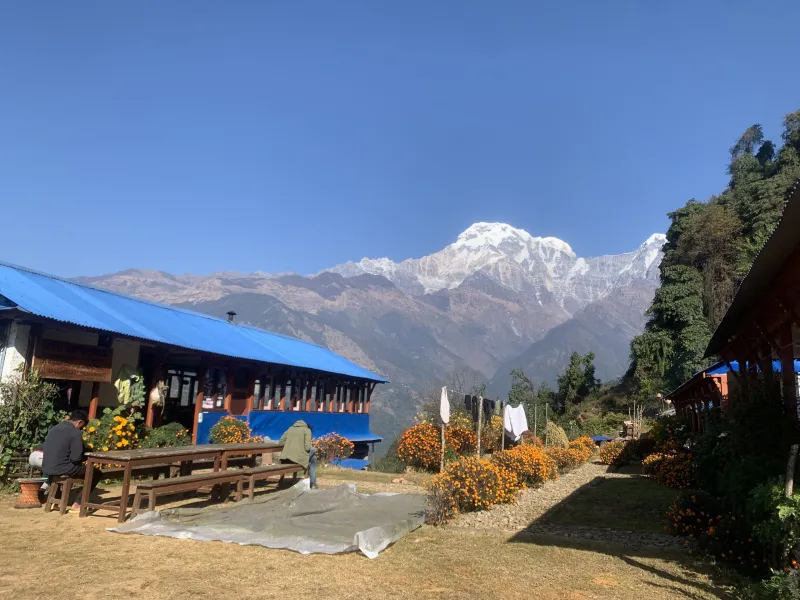
Leave Pokhara early for a 2.5–3 hour drive to Siwai, ahead of the day's heat. From Siwai the trail climbs through terraced farmland and Gurung villages, finishing with a long stone-staircase ascent to Chhomrong, the gateway village to the Annapurna Sanctuary, facing Annapurna South and Machhapuchhre head-on. Chhomrong has excellent lodges and the last well-stocked shops of the trek.

Day 1 of 6

Drive to Siwai, Trek to Chhomrong

Pokhara → Siwai (drive) → Chhomrong

Altitude: Siwai ~1,300 m → Chhomrong 2,170 m
Time: 4–5 h walking (+ 2.5–3 h drive)
Overnight: Chhomrong (2,170 m)

Leave Pokhara early for a 2.5–3 hour drive to Siwai, ahead of the day's heat. From Siwai the trail climbs through terraced farmland and Gurung villages, finishing with a long stone-staircase ascent to Chhomrong, the gateway village to the Annapurna Sanctuary, facing Annapurna South and Machhapuchhre head-on. Chhomrong has excellent lodges and the last well-stocked shops of the trek.

Depending on road conditions, jeeps sometimes continue past Siwai toward Jhinu Danda's new bridge, cutting an hour of walking — ask your driver.
Day 2

Chhomrong to Himalaya

Day 2

Chhomrong to Himalaya

Chhomrong → Sinuwa → Bamboo → Dovan → Himalaya

Overnight: Himalaya (2,920 m)

The day starts with Chhomrong's roughly 2,500 stone steps down to the Chhomrong Khola, then a stiff climb to Sinuwa (2,360 m), where the trail enters the Sanctuary proper. It continues through bamboo and rhododendron forest to Bamboo (2,310 m), then climbs past mossy waterfalls to Dovan (2,600 m) for lunch, and on to Himalaya (2,920 m), a small lodge cluster deep in the gorge.

Day 2 of 6

Chhomrong to Himalaya

Chhomrong → Sinuwa → Bamboo → Dovan → Himalaya

Altitude: 2,170 m → 2,920 m (net +750 m, with big descents and climbs in between)
Time: 6–7 h
Overnight: Himalaya (2,920 m)

The day starts with Chhomrong's roughly 2,500 stone steps down to the Chhomrong Khola, then a stiff climb to Sinuwa (2,360 m), where the trail enters the Sanctuary proper. It continues through bamboo and rhododendron forest to Bamboo (2,310 m), then climbs past mossy waterfalls to Dovan (2,600 m) for lunch, and on to Himalaya (2,920 m), a small lodge cluster deep in the gorge.

In spring, this forest section is a tunnel of red and pink rhododendron blooms — one of the trek's highlights.

Day 3

Himalaya to Machhapuchhre Base Camp

Day 3

Himalaya to Machhapuchhre Base Camp

Himalaya → Deurali → Machhapuchhre Base Camp

Overnight: Machhapuchhre Base Camp (3,700 m)

Climb past the Hinku Cave overhang to Deurali (3,230 m) for an early lunch, where the valley opens and the trees vanish. The stretch above Deurali to MBC crosses several avalanche chutes, dangerous after heavy snowfall in winter and early spring, so an early start and no lingering is the plan. The trail emerges at the mouth of the Sanctuary at Machhapuchhre Base Camp, ringed by Machhapuchhre's fishtail summit, Annapurna III, and Gangapurna.

Day 3 of 6

Himalaya to Machhapuchhre Base Camp

Himalaya → Deurali → Machhapuchhre Base Camp

Altitude: 2,920 m → 3,700 m (+780 m)
Time: 4–5 h
Overnight: Machhapuchhre Base Camp (3,700 m)

Climb past the Hinku Cave overhang to Deurali (3,230 m) for an early lunch, where the valley opens and the trees vanish. The stretch above Deurali to MBC crosses several avalanche chutes, dangerous after heavy snowfall in winter and early spring, so an early start and no lingering is the plan. The trail emerges at the mouth of the Sanctuary at Machhapuchhre Base Camp, ringed by Machhapuchhre's fishtail summit, Annapurna III, and Gangapurna.

If anyone in the group has a worsening headache or nausea at MBC, stay a second night or descend — do not push to ABC.

Day 4

Annapurna Base Camp — Full Day in the Sanctuary

Day 4

Annapurna Base Camp — Full Day in the Sanctuary

MBC → Annapurna Base Camp

Overnight: Annapurna Base Camp (4,130 m)

A gentle two-hour climb up the alpine meadow, often through frost or fresh snow, brings you into the heart of the Annapurna Sanctuary, a 360° amphitheater with Annapurna I (8,091 m) towering over the glacier at its head, flanked by Annapurna South, Hiunchuli, Tent Peak, and Machhapuchhre behind you. Arriving fresh by mid-morning leaves the whole day to explore the memorial chortens, walk the moraine rim, and settle in for sunset, when the entire cirque turns gold and pink.

Day 4 of 6

Annapurna Base Camp — Full Day in the Sanctuary

MBC → Annapurna Base Camp

Altitude: 3,700 m → 4,130 m (+430 m)
Time: ~2 h walking up; the rest of the day is free
Overnight: Annapurna Base Camp (4,130 m)

A gentle two-hour climb up the alpine meadow, often through frost or fresh snow, brings you into the heart of the Annapurna Sanctuary, a 360° amphitheater with Annapurna I (8,091 m) towering over the glacier at its head, flanked by Annapurna South, Hiunchuli, Tent Peak, and Machhapuchhre behind you. Arriving fresh by mid-morning leaves the whole day to explore the memorial chortens, walk the moraine rim, and settle in for sunset, when the entire cirque turns gold and pink.

Both sunset and sunrise from ABC are world-class; with this schedule you get both.

Day 5

Sunrise at ABC, Descend to Bamboo

Day 5

Sunrise at ABC, Descend to Bamboo

ABC → MBC → Deurali → Himalaya → Dovan → Bamboo

Overnight: Bamboo (2,310 m)

Be outside before dawn for sunrise on Annapurna I from Base Camp, then begin the long descent after breakfast: past MBC, through the avalanche section (again, earlier is safer in snow season), then through Himalaya and Dovan, down through the forest to Bamboo.

Day 5 of 6

Sunrise at ABC, Descend to Bamboo

ABC → MBC → Deurali → Himalaya → Dovan → Bamboo

Altitude: 4,130 m → 2,310 m (−1,820 m)
Time: 6–7 h
Overnight: Bamboo (2,310 m)

Be outside before dawn for sunrise on Annapurna I from Base Camp, then begin the long descent after breakfast: past MBC, through the avalanche section (again, earlier is safer in snow season), then through Himalaya and Dovan, down through the forest to Bamboo.

Poles help enormously on the long knee-punishing descent.

Day 6

Bamboo to Jhinu Hot Springs, Drive to Pokhara

Day 6

Bamboo to Jhinu Hot Springs, Drive to Pokhara

Bamboo → Chhomrong → Jhinu Danda → Siwai → Pokhara

Overnight: Pokhara

Climb back to Sinuwa, descend the stone steps to the river, and grind back up to Chhomrong one last time before heading downhill to Jhinu Danda. The natural hot springs by the Modi Khola, 20–30 minutes below the village, are the reward for six days of stairs. Cross the long suspension bridge below Jhinu and walk the last easy stretch to the road at Siwai, where a jeep takes you back to Pokhara.

Day 6 of 6

Bamboo to Jhinu Hot Springs, Drive to Pokhara

Bamboo → Chhomrong → Jhinu Danda → Siwai → Pokhara

Altitude: 2,310 m → Jhinu Danda 1,780 m
Time: 6–7 h walking (+ 2.5–3 h drive)
Overnight: Pokhara

Climb back to Sinuwa, descend the stone steps to the river, and grind back up to Chhomrong one last time before heading downhill to Jhinu Danda. The natural hot springs by the Modi Khola, 20–30 minutes below the village, are the reward for six days of stairs. Cross the long suspension bridge below Jhinu and walk the last easy stretch to the road at Siwai, where a jeep takes you back to Pokhara.

If you want the hot springs without the rush, ask your jeep for a later pickup, or overnight in Jhinu and drive early the next morning.

Essential Gear

  • Sleeping bag rated to about −10 °C (lodges provide blankets, but ABC nights are cold)
  • Trekking poles — the trek is famous for its thousands of stone steps
  • Water purification tablets or filter
  • Sun protection: the Sanctuary is a snow bowl and glare is strong
  • Headlamp for sunrise viewing at ABC
  • Microspikes in winter/early spring for the icy stretch above Deurali

Good to Know

  • This is a fast ascent profile — from about 1,300 m to 4,130 m in four days. Know the AMS symptoms (headache, nausea, dizziness, poor sleep) and never ascend with worsening symptoms; descending is the cure.
  • The Deurali–Machhapuchhre Base Camp stretch crosses avalanche chutes that become dangerous after heavy snowfall in winter and early spring — cross early in the day, move quickly, and follow lodge advice.
  • Consider Diamox as a prophylactic given the compressed schedule; consult a doctor first.
  • Get travel insurance covering trekking above 4,000 m and helicopter evacuation.
  • Permits are obtained in Pokhara at the Nepal Tourism Board office, Damside; carry your passport and a few passport photos.
  • If you can spare one more day, a 7-day version sleeping an extra night lower down makes the trip both safer and more enjoyable.
  • Monsoon season (June–September) brings leeches, rain, and hidden mountains and is not recommended; winter (Dec–Feb) is possible but the avalanche section is a genuine hazard.
  • Typical daily rhythm: wake 6–6:30 am (5 am for the ABC sunrise), breakfast, walk with a tea or lunch stop, arrive early-to-mid afternoon, order dinner by around 6:30 pm, sleep by 9 pm.

Ready to trek Annapurna Base Camp Trek?

Talk to a specialist who has personally trekked every route we sell — no call center, no script.

Call / WhatsApp Plan My Trek